I hadn’t really considered voltage until I had a conversation with a colleague earlier this week. I incorrectly assumed that the UK domestic system runs at 240 volts all the time. I had also incorrectly associated NESO maintaining the whole system frequency at 50 Hz as the same as maintaining voltage.
Wrong on both counts...
It’s over 30 years since the UK changed to a system based on 230 volts. This enabled greater harmonisation with Europe which runs at 220 volts which is within the UK upper and lower limits on voltage were set at 216 volts (-6%) and 253 volts (+10%).
The national frequency should be between 49.5 and 50.5 Hz, but it is much more closely managed with NESO controlling this on a second-by-second basis. If the demand exceeds supply on the system, then the frequency drops, think of it like driving a car up a hill – the revs drop as the incline kicks in. So NESO’s tight management implies that the whole system is balanced.
Voltage is more local. It depends on conditions on the distribution network, cable lengths, local demand, embedded generation, transformers, and how the network is operated.
Whilst the whole system is balanced, local parts of it might not be, there might be more demand in my town than the local network is configured to supply, or as I discovered the supply to my house cannot keep up with my overnight demands.
This isn’t a problem with the size of the cables or fuses in my house; these are plenty large enough. It’s the ability of the local system to provide power.
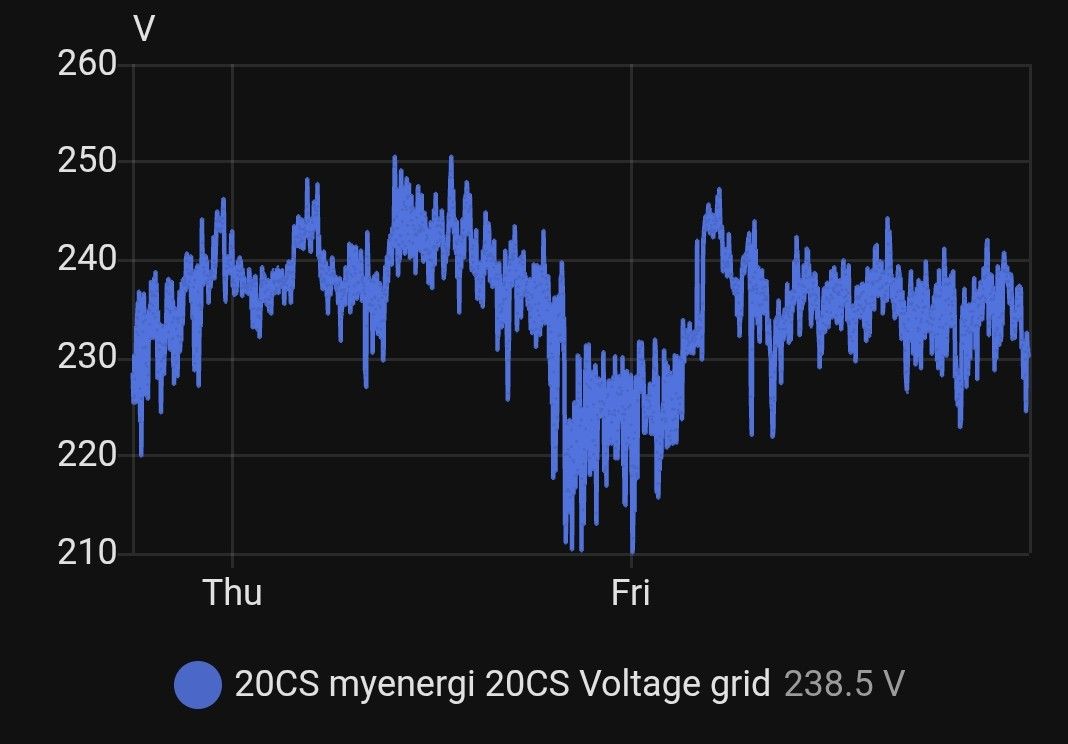
The image below shows an evening a couple of weeks ago when my EV charger kicked in at the same time as the washing machine and dishwasher. The voltage dipped to 210 volts, below the 216 volt limit.
Appliances are designed to expect voltages in the defined range, for some this means drawing more current, increasing the heat and load, decreasing efficiency, and the possibility that they may trip off to protect themselves.
This is going to happen more frequently as more people get EVs, batteries and smart devices that kick in in response to price signals.
Smart meters can collect voltage information, but the delay in relaying this means the information is out of date before it arrives. Real time communication from meters could help all levels of the network operate more effectively.
We’re likely to hear a lot more about power quality in the next few years.