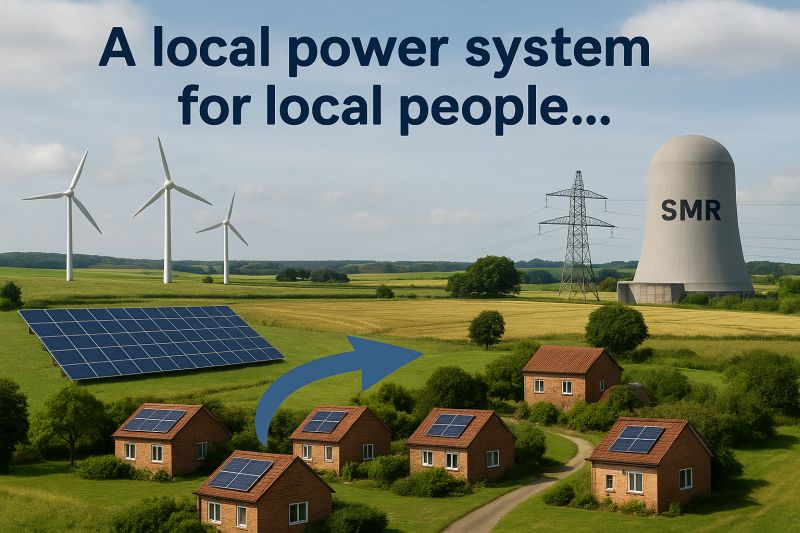
Imagine a system where all domestic power is generated and distributed locally, and only commercial and industrial power is generated and transmitted nationally?
Our imaginary town has 10,000 homes each using the national average of 2,700 kWh of electricity and 11,500 kWh of gas. Unfortunately, this town hasn’t got its own source of gas, so we need to find 14,200 kWh of electricity per house or 142 GWh of electricity for the town.
The town is surrounded by fields so we can set about installing a solar farm. A hectare (a 100m square) of solar panels will generate around 480 MWh per year, so we would need just under 300 hectares of solar farms. The UK average farm is 80 hectares, so we need to replace 4 farms with solar farms per town. Maybe that’s too many, as we’ll need them for new housing estates.
The next choice could be a local wind farm, where we could continue farming the land, but not build houses. We could add 24 turbines each of which could generate 6 GWh per year. At £5m each this would cost £120m, £12k per house.
But the wind doesn’t always blow, so we need to store the power, we need a battery. If we need to store two days’ worth of power for the town then we’ll need a battery capable of storing around 800 MWh. Which would cost around £80m, £8,000 per house. This pushes the wind-battery combination to £20,000 per house.
The next choice is a nuclear SMR on a semi-industrial site on the outskirts of town, we’d need around a 20MW plant which could cost £100m, or about £10,000 per home.
Perhaps we should head back to the house and ask ourselves whether that level of load is necessary. We could install heat pumps, heat networks (possibly run off our SMR), and insulation to bring down the demand. Houses could have their own solar panels and their own battery, and each one needs a hot water tank. The batteries in 10,000 EVs could have a capacity of 750 MWh so we don’t need that battery.
Maybe there is also a role for more innovative technologies, particularly in local storage, salt batteries, or deep hot water stores. Maybe this is where hydrogen will find its role?
This is unlikely to happen without coordinated local planning, with key players being local authorities, distribution companies and NESO with its regional planning (RESP) role.
Time to get around the drawing board.