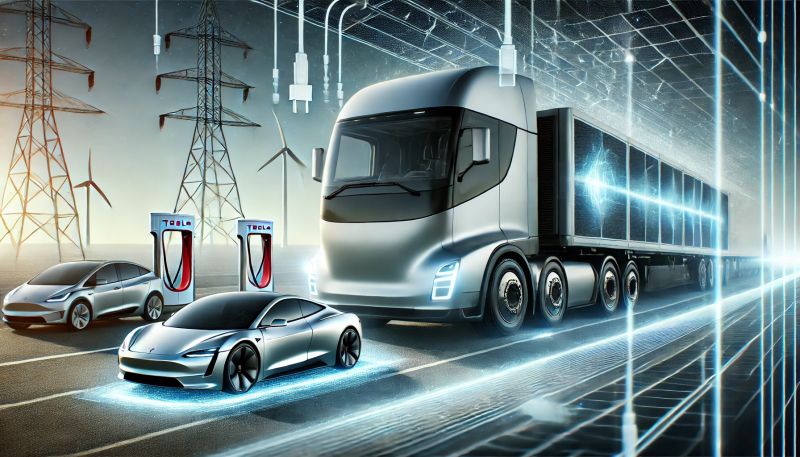
Almost all batteries in use today have a liquid component that separates the positive and negative sides. Replacing this with a solid transforms battery capacity and weight, unlocking the next generation of electric transport.
In a Telsa model 3 the battery weighs 480 kg with a range of up to 600 km, and stores 75KWh of electricity. So, it’s just over 1kg per km of range and a energy density of 150 Watt hours per kg.
A solid-state battery could have a density over 350 Wh per kg. This means the Tesla battery would weigh just over 200 kg while maintaining the same range.
This is exciting for the EVs that will be bought in the last years of this decade, but this is transformational for how heavy haulage will operate.
Scania are planning to build a truck with a 500 KWh capacity, which would weigh over 3 tonnes, but as a solid-state battery would be around 1.5 tonnes. Scandia point out that this gives enough range for the maximum 4.5-hour journey allowed under European law.
Development of solid-state batteries raise serious questions for those that view Hydrogen as a future fuel for trucks. By the end of this decade, the charging network should be sufficient to keep the trucks rolling, whereas Hydrogen would require new infrastructure and a new supply chain.
This all raises questions for policy makers, including what subsidy mechanisms should be in place for the next 5 years, and what trials should be supported.