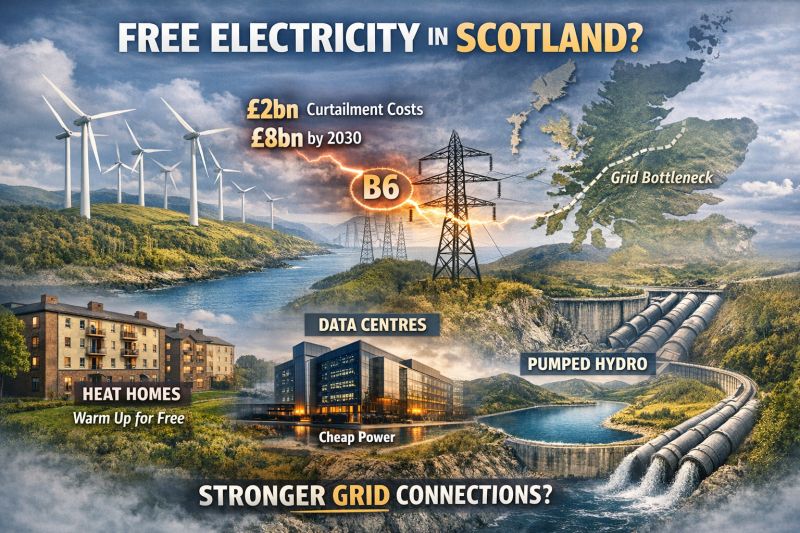
The challenge of curtailment costs is well publicised. NESO say that this will be £2bn this year and £8bn by the end of the decade. These are payments made in the Balancing Mechanism to mostly wind farms in Scotland to compensate them for being asked to turn off.
A key reason for this is that there is a physical constraint in the size of the grid between Scotland and England. This is known as the B6 boundary, but it also includes other connection points B5 and EC5. Pushing too much power through these places risks overheating and burning out the grid, which could take months if not years to repair.
Perhaps there is a silver lining for the people and businesses of Scotland?
A first win for Scotland could be the thousands of social houses that have electric storage heaters. These are physical batteries, literally blocks of concrete attached to walls, they are also already remotely controlled. When the grid has excess power, these homes could be warmed up at very low cost.
The next opportunity is data centres. A large data centre could be a player in the same balancing mechanism that is paying wind farms not to produce and could bid in to take some of this power at a very low price.
Pumped hydro electric is proven technology that can provide solid long-term returns for investors. SSE have announced a 1.3 GW plant (about the same capacity as a single large nuclear reactor). If more sites can be found then this could bring in a lot of investment.
Clearly the long-term answer is to build stronger transmission connections between Scotland and England. Frustratingly the Scottish transmission companies have built many kilometres of new lines out to the wind farms, but this has not yet stretched across the border.
Perhaps I am missing some of the downsides, but these all feel achievable?