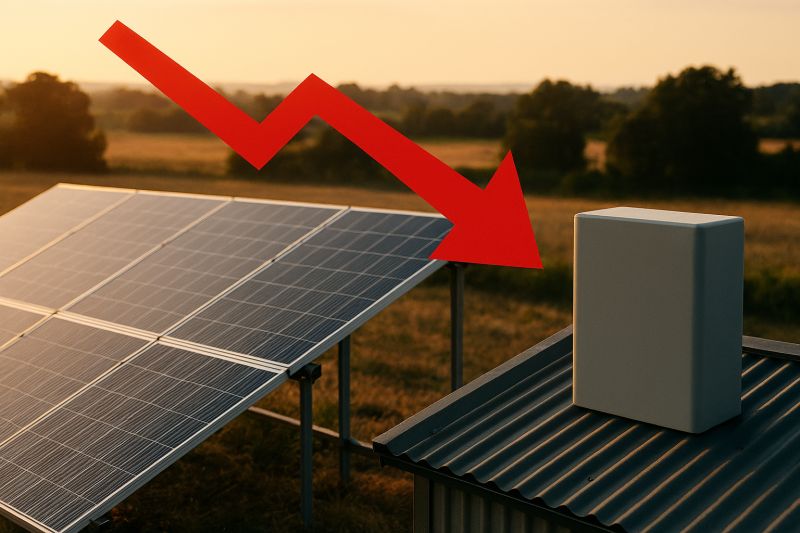
This week, in a very carefully worded email, Octopus told me that they were cutting the rate they pay me for exporting electricity to the grid from 15p to 12p per kWh. That’s a 20% reduction.
On sunny summer afternoons my battery is full and power from my solar panels flows backwards into the grid. Across the summer I can expect to make about £100 from this, now reduced to £80.
This arrangement is provided under the Smart Export Guarantee (SEG) scheme, which is a fairly simple set of rules (for the energy industry) that requires most suppliers to offer these payments. It replaced an earlier and more lucrative scheme called the Feed in Tariff.
The Octopus email does a good job of explaining why the export rewards are so much lower than the import costs: network and other charges are only levied on the import costs; the exporter is effectively freeriding on the importer paying these costs. Although it is confused over whether wholesale costs are going up or down.
Another interesting component of the SEG rules is that ‘brown’ exports are explicitly excluded, this is where I fill my battery at night on cheap electricity and then export during the day. As far as I know from my set up Octopus has no way of knowing where my exported power has come from.
The reduction in rates matters because it changes investment payback periods and therefore undermines consumer trust.
Unlike the price for buying electricity there is no price protection for consumers, Octopus could reduce the payment further and I would have no recourse. In parallel the older Feed in Tariff scheme has also been changed to index from RPI to the lower CPI resulting in lower returns, with no meaningful consumer engagement on the topic.
This also matters for flexibility markets. Consumers need long term trust in their returns if we are asking them to invest thousands in flexibility assets like batteries, solar panels, and heat pumps.
So perhaps time for price and service regulation of the ‘grey’ area of our consumer market where low carbon and flexible products and services are offered to consumers with speculative returns and payback periods.