Wednesday’s King’s speech reiterated the government’s commitment to not allowing new drilling in the North Sea. This effectively stops any projects at the drawing board.
We are not making progress with replacing our existing gas fired generation fleet. Mostly it’s over 2 decades old and will reach end of life in the next 10 years. Unless new market mechanisms to support their replacement are created, we will see dwindling capacity levels from 2030 onwards.
Renewable energy and batteries will play a central role in our future energy system, with a healthy pipeline. We may even be well ahead of where we expected to be with solar. Yet we are still to run the whole system carbon free for a single 30 minutes’ period, let alone the 17 thousand periods every year. Winter operations and system stability remain to be proven in renewables.
The UK’s insatiable demand for energy outstrips our geographical ability to provide it; we will be importers of energy for the rest of this century and never isolated from global energy crises. Regardless of the argument that we pay the global price for oil and gas anyway this is no use if the supply lines are blocked and we have not local supply.
Last week EDF released a video showing progress at the new nuclear power station HPC, and whilst its issues with delays and costs are well documented, it does appear to have passed the point where the largest construction challenges have been addressed. The second site at Sizewell is still little more than earthworks, but there is good reason to believe that it can be delivered to a tighter schedule and price than HPC.
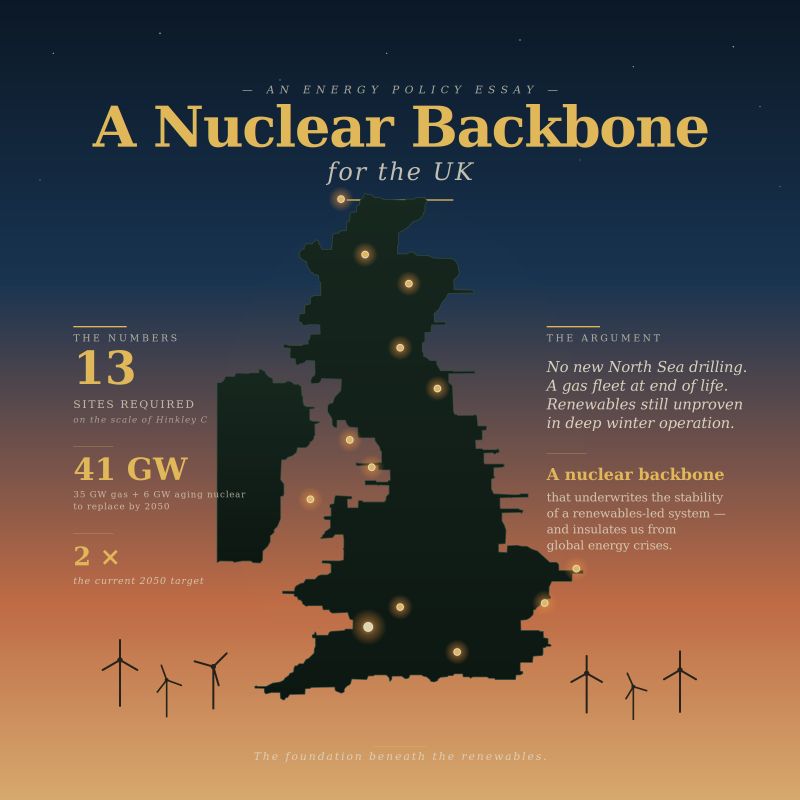
Replacing our gas fired capacity of 35 GW and replacing the existing aging nuclear fleet of around 6 GW, will need 13 sites like HPC or Sizewell. This is about double the existing government target for 2050.
A more ambitious nuclear plan is needed. A ‘Nuclear Backbone’ for the UK that underwrites the stability of our renewables-based system and provides some insulation from global energy crises.