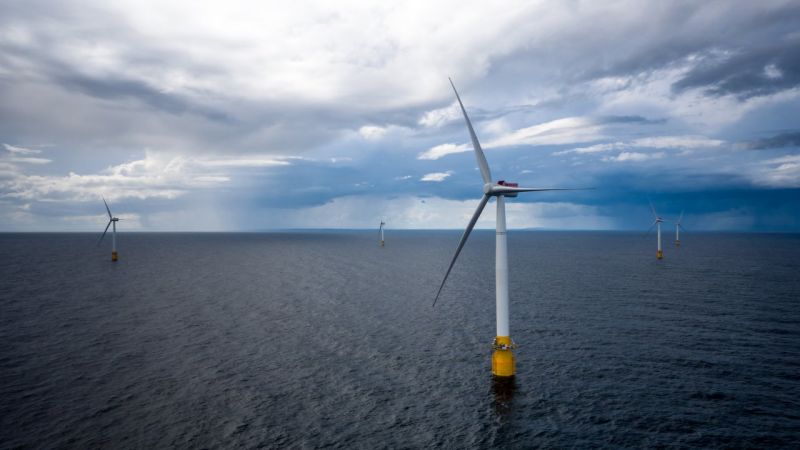
To the east of Aberdeen is the Kincardine floating offshore wind (FLOW) field, it’s rated at 50MW. Further north there’s another FLOW field called Hywind which has 30MW capacity.
Together these account for one third of global floating offshore wind capacity.
When operational FLOW fields have much higher capacity factors of up to 60% than fixed bottom offshore wind turbines, typically 35%. (what it actually produces vs its theoretical maximum production)
This proves the case that floating offshore wind can be deployed in places with higher and more consistent windspeeds and be operational more of the time.
But FLOW platforms are considerably harder to install and maintain than their fixed cousins. The platform bobs around in the swell, long heavy cables are needed to keep them in place, and there still needs to be something heavy on the seabed to hold it all down. The power cable also needs to be connected, and this may need an additional offshore substation that could either float or sit on the bottom.
Seawater is extremely corrosive, particularly to moving parts. Maintenance far offshore is challenging and can take many months, with some equipment needing to be towed back to port to be worked on.
Does the increased yield from floating offshore wind make the economics pay?
The £500m cost for Kincardine at £10m per MW cannot be taken as representative of future FLOW fields, it was the first of its kind and many improvements will be made. Even with the higher capacity figures this would need to be halved to be competitive with fixed bottom wind.
Many think this is possible, but developers like Equinor point out that we need to look at much larger GW scale projects and have a step change in collaboration (rather than competition) to deliver these savings.
Photo from Equinor