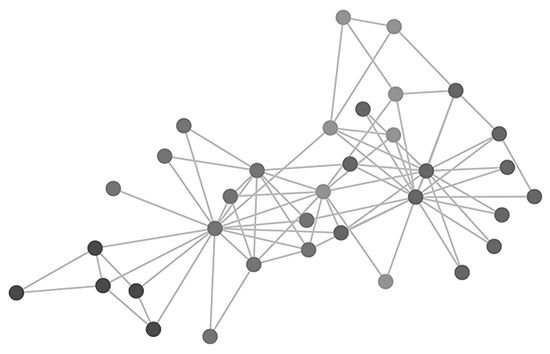
Forget value streams and value chains. The future winners in the energy markets will be those companies that can manage the Energy Mesh.
Traditional businesses were organised along value streams – upstream oil, electricity distribution, customer billing – were all parts of the energy value stream and it made sense to arrange businesses and to focus and optimise each part of the value stream. Matrix management had a role, but the primary P&L was value stream led.
The future is a lot more complex, a lot more interconnected and hence more like a mesh than a stream.
We plotted the flows that would be required to run a Charging as a Service business. The page has around 50 interconnecting lines, the flow of energy, money, data and agreements needed to be managed to bring this service to market. Mastery of everything from Network Connection Agreements to Transmission Charging Mechanisms to Car Data to Physical Switching of Charging Stations is needed.
Future winners in the Energy Markets will optimise these meshes. Their core competency will have more to do with Graph Theory than with Lean Operations. Their organisations will be capability based rather than functionally based. Their people will create and manage connections in the mesh. They will manage the mesh as a system of systems. They will be winners because they are able to bring services to market that traditional businesses cannot.
How to change to being a mesh-based organisation? I’d start by getting a deep understanding of the fundamental flows in the Energy Market – power, money, data and agreements. Then map these to the services that you see a future demand for.
Managing a Mesh is a NP problem, managing a process is a P problem. There’s a lot more value in solving NP problems. (P = easy, NP = hard)