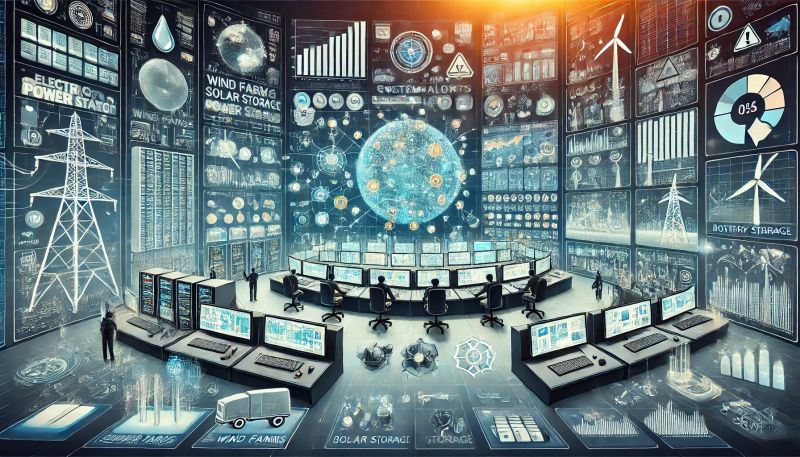
Every day the UK electricity control room issues over 10,000 instructions to keep the system balanced. The assets receiving these instructions are known as Balancing Mechanism (BM) Units.
There are just under 800 Primary BM Units which are the large, connected assets such as power stations and windfarms. Smaller assets, such as solar farms and charging stations, are grouped together as Secondary BM Units under the direct control of an aggregator known as a Virtual Lead Party, there are currently 15 VLPs.
Traditional assets, like a gas fired power station, will take time to ramp up production, will have a minimum time for running, and then a time to ramp down again. Newer assets like batteries have different patterns, they can turn to full load very quickly, will have a maximum time they can run for, and will then switch off quickly. A data centre could have a very unpredictable load as it responds to user demands.
With rapid growth in the number and variety of connected assets, to keep the system balanced, the future control room will need complete visibility of their location and current state, their potential operating characteristics, and a real time view of the market to see how price signals are driving consumption patterns.
It’s likely that we are not too far away from this being too complex for humans to manage.
We are going to need technology to help, but this is more than putting a more powerful chip into the existing systems. We need to develop the algorithms and embed them in new systems.
These algorithms will need to predict how demand and supply will behave and not assume that every asset is an entirely rational actor, as there may be financial gains to be made by playing the system. There’s a frightening case where everything is controlled by computers and undesirable results occur, like super high prices (as happened in financial markets), or blackouts. We will need robust controls on the systems.
The way that the Internet works provides interesting ways of looking at and solving this problem, but it is mostly based on distributed rather than centralised control which makes it more robust and less vulnerable to central control issues. Perhaps we need to borrrow solutions from here for the energy complexity challenge?