I prematurely switched off our heating this week, but put it back on at lunchtime today as the sunny weather isn’t turning into enough warmth just yet. This also coincided a visit from a heating engineer to look at installing an ASHP and with me making some changes to my home automation set up.
The key question is are we systematically over sizing our heating systems? If we are we are baking in significant and unnecessary system costs.
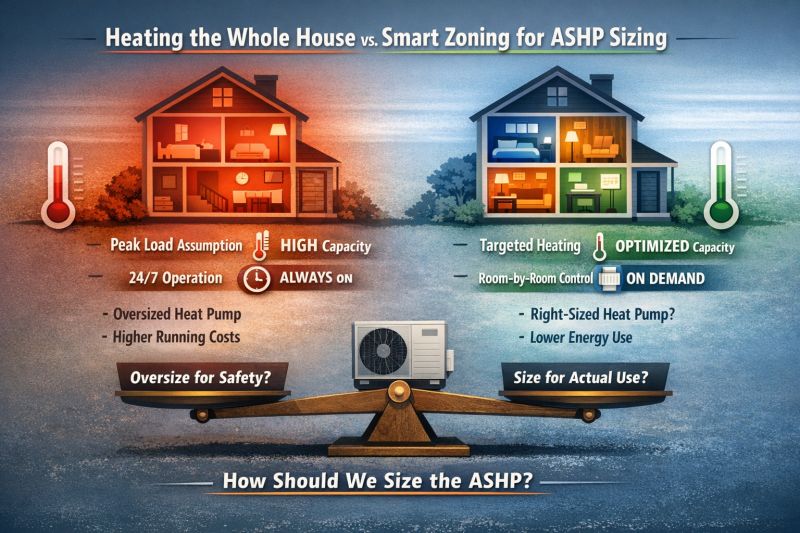
Often ASHPs are run 24x7 as the guidance is that the home needs to be constantly warmed by low flow temperatures to achieve comfort levels throughout. Also cycling heat pump compressors off and on is less efficient. But this always-on heat comes at a cost.
An alternative is to zone the house so that it only heat to match occupancy - the downstairs during the day, and upstairs at night. In a well-insulated home this can halve the energy needed, but it needs piping and valves that allows this.
Taking this further each room can be individually controlled. A £25 smart radiator valve could only heat rooms for the hours that each is used. ASHP heating needs to kick in earlier than a gas boiler as the lower flow temperatures take longer to warm the room. This could potentially reduce the total energy demand by two thirds compared to the ‘heat the whole house’ approach.
The evidence from controlling each room in my house over this winter is compelling for a gas fired system. Each room TRV has saved around £18 in comparison to letting the overall house thermostat take control. A good return on investment.
Total energy use and peak power consumption are often treated as the same thing; a good design can reduce both.
The software used to calculate home heat losses suggests that we need a large ASHP, this is also close to the EPC base calculation. But I’m not sure it’s right.
I’ve looked at our peak half hourly gas use over the winter and it’s a fraction (25%) of what is being calculated, even when considering the different system characteristic this is too large to ignore.
What remains is a design dilemma between the heating engineer, my plumber, and me on how to size the ASHP. Do we risk assuming that the same approach will work or do we bump up the heat pump size just in case?
Control strategy appears to be a secondary consideration in system design, but it should be at the forefront. Oversizing ASHPs is understandable in response to uncertainty, but it could be a costly choice.
My installer might feel more comfortable oversizing rather than have a chilly and upset customer.