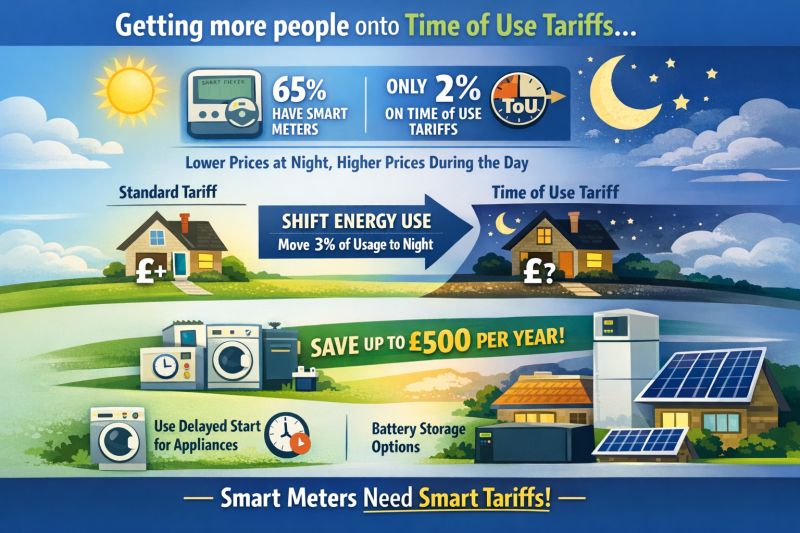
According to Ofgem, whilst 65% of households have a smart meter, only just over 2% are on modern Time of Use tariffs (ToU = lower prices overnight, higher during the day), a further 7% are on legacy day-night tariffs such as Economy 7.
This is a missed opportunity for both a better system and cost savings.
With current profiles many consumers would be slightly worse off under a ToU tariff. I plugged the Elexon standard domestic profile along with the average UK consumption (used for the price cap calculations) and found that a typical consumer’s bill might increase by £22 per year if they shifted to a ToU tariff.
But they would only need to shift 3% of their consumption from day to night periods to break even and everything greater than this is profit. This goes all the way up to £500 saving if everything can be switched to the night rate, which would need a battery.
3% shift in consumption is very achievable – most dishwashers, washing machines and tumble driers have delayed start timer functions. The high cost of batteries is a concern for households, so we could see part-ownership and leasing deals coming to market, where the leasing company get some of the returns and the home gets their savings underwritten.
Some consumer protections are in order. I am told that retailers are making losses on these cheap overnight tariffs, so there is always the risk that consumers deploy low carbon technologies like batteries only to see them removed or the prices hiked. Perhaps a requirement that the day-night price difference must reflect prevailing market prices?
Unless we push harder on ToU we risk having a smart metering network that is effectively operating in semi-dumb-meter mode where we have solved the estimated bills problem but are missing the whole system benefits.
And we need to drive ToU adoption as a prerequisitie for flexibility.