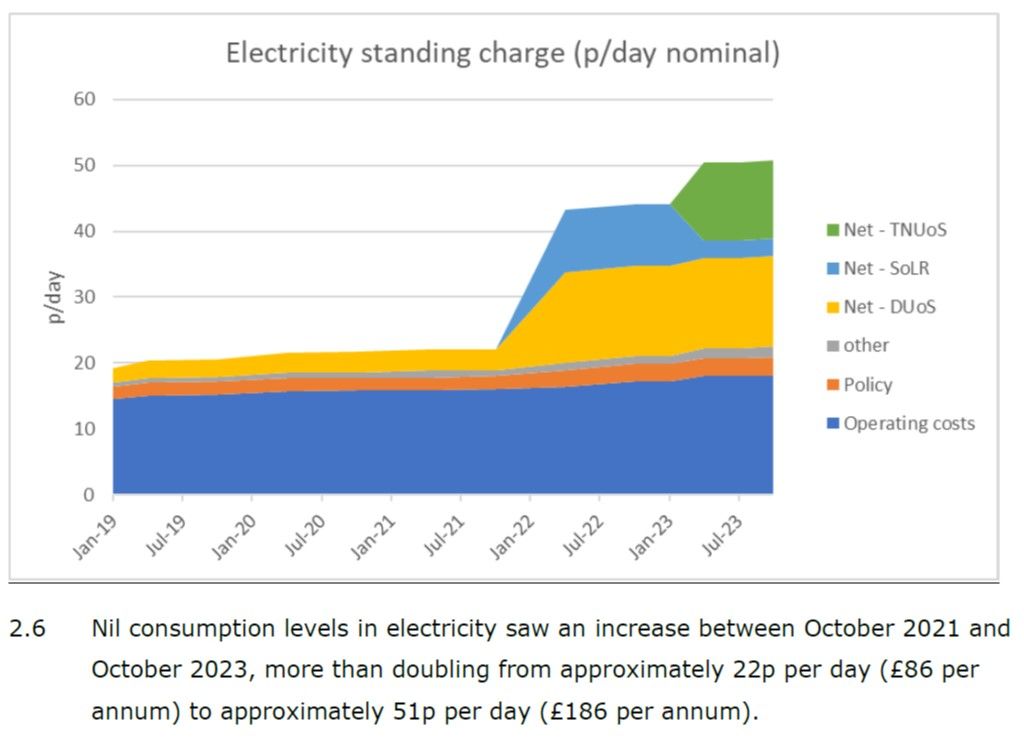
The standing charge is a political hot potato. In the UK the regulator has just issued a very well structured consultation on its future direction. According to Ofgem the average electricity standing charge is £186, roughly twice where it was three years ago.
The dynamics of the energy system are changing. We are moving from a fossil fuel world where a large part of the cost of energy was related to fuel prices, to a renewables world where the cost is related to the costs of building assets such as wind turbines. In this respect many of the costs of the system are becoming more fixed, perhaps the standing charge should increase?
Ofgem says that the standing charge covers fixed operational and network infrastructure costs, I’m not sure that this is entirely right. If we go with their assumption, as we will need to build three times the network that we have today in the next 30 years, which is a big heap of fixed asset costs (ie not related to the cost of fuel), this would vastly increase the standing charge.
The standing charge is regressive, the less energy you use the greater the proportion of your bill that it represents. If you are an average user, it is about 18% of the cost, if you have 6 bedrooms and a swimming pool then it could be 3%. Reducing the standing charge is generally good for those on lower incomes, but Ofgem make a good point that generally good is the same as good for everyone and some on low incomes would face higher charges.
Energy retail companies aren’t required to levy a standing charge, they could have a tariff that is 100% energy costs (ie per kWh). The key reason for not doing this is customers with very low usage still incur costs that need to be recovered.
I’ve been a long-term supporter of a block multi-tier tariff. Here the customer pays a low rate for the first units of electricity per day (say the first 2 kWh per day) and a progressively higher rate for the next tier and so on. This has the advantage of ensuring a basic level of electricity is more affordable, whereas those who use more also pay more. These tariffs can operate without a standing charge. They can also be linked to healthcare and benefits so that those unable to pay or using more can get support.
Longer term we also need to more closely link the economics and dynamics of the physical system to the retail market. Flexibility and availability charging will need to be features of our future tariff design.