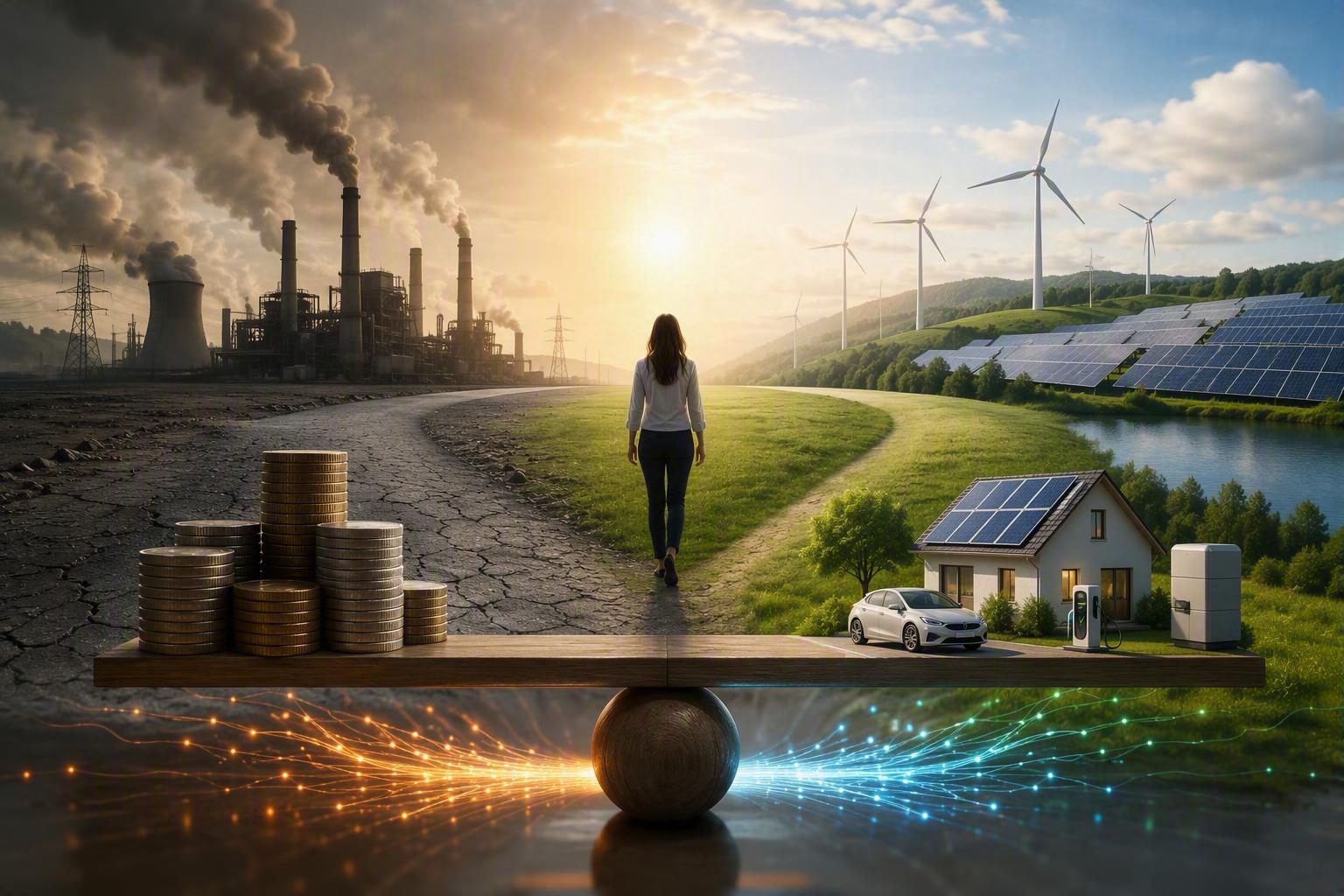
Build less of the dirty stuff whilst building more of the clean and the system will automatically rebalance to a low carbon system. This is a purely physical argument that is doomed.
But, reducing the price gap between clean and fossil energy may deliver more long-term decarbonisation than hitting short term carbon targets. Which might sound counterintuitive.
Decarbonisation is not purely a construction programme. It is a society and economic transition that not only needs new types of physical assets it also needs a new economic model. The money flows through the system must be managed in tandem with the power.
We’re seeing that the physical only approach is loading costs into the system. Full system costs include balancing, transmission, storage, backup generation, flexibility and financing costs. LCOE is not how consumers make decisions, they decide on the whole system costs that are passed on to them.
The fundamental societal question is how do we get people to choose to electrify?
Net Zero is a destination, not a design principle.
Good design principles create productive tension between competing objectives. "Decarbonise at any cost" is not a useful principle because it ignores affordability. We should add this tension by redefining the principle to progressively reduce emissions and whilst making clean energy cheaper than fossil energy.
The Climate Change Committee should track two budgets rather than one: a carbon budget; and an electricity-versus-fossil-fuel price-gap budget. One tells us whether emissions are falling. The other tells us whether consumers are likely to come with us.
Governments that think they can subsidise or legislate to decarbonisation will run out of money or political support very quickly. A more important focus is making decarbonisation the economically rational choice.
Finding a pathway that gets us there is the challenge. One that is investable, affordable and politically acceptable at every stage of the journey.
If this is done, consumers will do much of the work themselves.