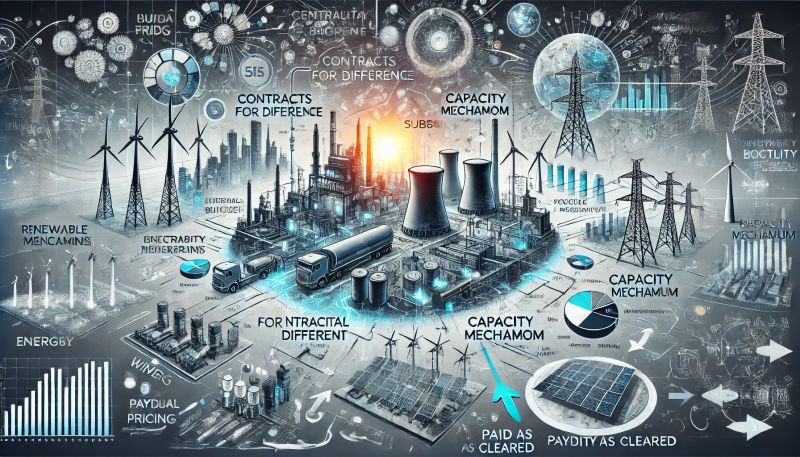
All electricity generation is under a subsidy mechanism of some kind. This point was made during the launch of ESO’s Future Energy Scenarios, the presenter then said that given this we need to have a careful look at how Marginal Pricing works.
Marginal Pricing works by generators putting in bids for the price they are prepared to generate at, the system operator then chooses the cheapest first, but the market price is set by the last and most expensive bidder, this is known as Paid as Cleared.
Subsidy schemes, influence what generators bid, so there is no completely free market in the bidding. For renewables there is a Contracts for Difference mechanism resulting in a set price for generation regardless of the Marginal Price. There is also the Capacity Mechanism that pays (mostly gas generators) to be available even if they are not generating. Other mechanisms cover nuclear, interconnectors, and hydro.
Subsidy is perhaps a misleading term, no government money is provided, each of these schemes has a mechanism for recovering money from the market and redistributing it.
A lot of work is going into how we redesign this market for the future. DESNZ’s Reform of Energy Markets Arrangements (REMA) has been through two rounds of consultation, although it’s not clear that this is top of Ed’s to-do list, as he (rightly) also wants to look at retail market reform.
We are in a difficult hybrid world of running two parallel energy systems, fossil fuel and renewables, and are trying the impossible task of making both systems work through the same market mechanisms.
Security of Supply is the overriding concern here. The mechanisms are designed to ensure that the lights never flicker. We need to design for the two-track system that will be with us for the next 50 years.