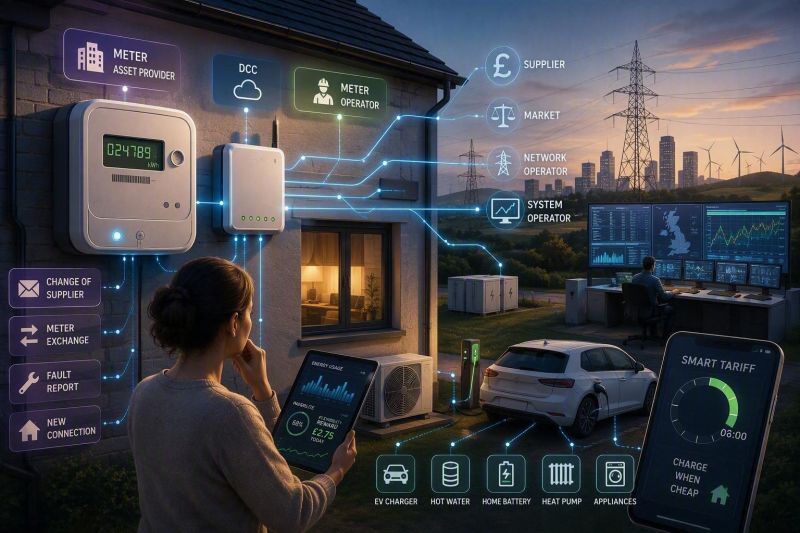
There’s pretty much nothing as complex in the energy system as metering. There are hundreds of arrangements and even different parts of the same meter can be owned by different parties.
The meter in your home may be owned by a leasing company known as a Meter Asset Provider (MAP), your supplier is ‘renting’ the meter from them so it can be provided to you, a different company known as a Meter Operator is responsible for installing and maintaining it, but the communications hub that allows it to speak to the outside world is owned by DCC. Following..?
If, like most people, you have switched supplier you have triggered a cottage industry of messages to keep everyone in the system informed of your new supplier. The new supplier is likely to take on the rental agreement with the MAP, opening and closing reads need to be aligned, registration and settlement systems need to be updated, and many more.
The industry has a good idea where most meters are installed, but there are meters linked to multiple addresses, addresses linked to multiple meters, related premises that don't align neatly with physical buildings, and decades of legacy data issues.
This all adds cost and complexity to the system, but it didn’t really matter that much.
But now we need the meter to be more than a route to more accurate bills. It is the gateway to consumer flexibility and time of use tariffs. It’s also the edge sensing device that network operators need to understand what is happening on the ground.
Building billion-pound flexibility markets on top of a system designed for periodic meter readings and monthly billing isn't a good fit.
The future system needs decisions and hence meters that operate in near real time, which is not possible with today’s half hourly time segments and daily polling of reads.
In the meantime, we are relying on estimating what might have happened and Synthetic Metering to fill in the gaps, ie taking coarse grained information and using algorithms to calculate what is probably happening in real time. It’s smart but might mean that flexibility payments might depend as much on models as they do on actual meter reads.
We need to urgently focus on the requirements for the next generation of meters, perhaps we should focus on this rather than getting the current generation of meters onto customers’ walls?