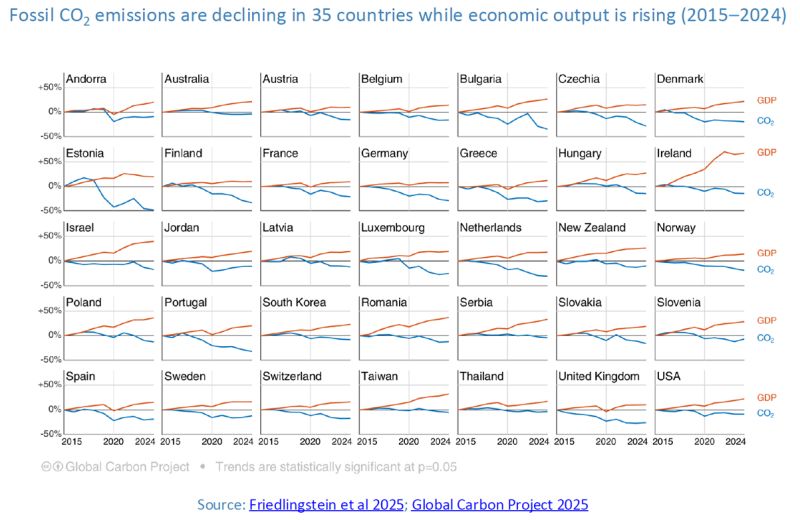
A December article in the Guardian suggests that strong government climate policies have succeeded in decoupling growth from emissions in 92% of the global economy. The article hopes that as we will soon reach a peak and climate change won’t be as bad as we feared.
We need to look more carefully at this.
A report from Exeter University also shows 35 economies that have grown whilst reducing emissions. On the surface, this suggests the two have been decoupled and we can now grow without harming the planet.
As we know, countries like the UK have exported their dirty industries like steelmaking to China, where production is just as dirty as it was here. If we counted what we now import from China, our figures wouldn’t look so good.
It is also easy to misread China’s own figures. Over the past decade, China has grown its economy by 50%, but its emissions have only grown by 24%. But this isn’t because the two have been completely decoupled. What has really been happening is that goods production has been increasing, but services growth has been faster, and so GDP growth has remained ahead of emissions growth.
Despite the headlines, the Exeter report itself shows that, globally, CO2 emissions continue to rise. In 1960, emissions were 10 gigatonnes per year and last year they reached 38 – growing at 2% every year. Meanwhile, World Bank figures suggest that over this period, global GDP also grew at 3.5% per year.
It’s clear that neither the global economy nor our global emissions are slowing, even if the graph below, for which countries have been carefully selected, makes it look like the job is done. If Exeter provided a global picture, the red and blue lines would both be above zero.
So if we can’t rely on decoupling, perhaps our lifestyles need to change.