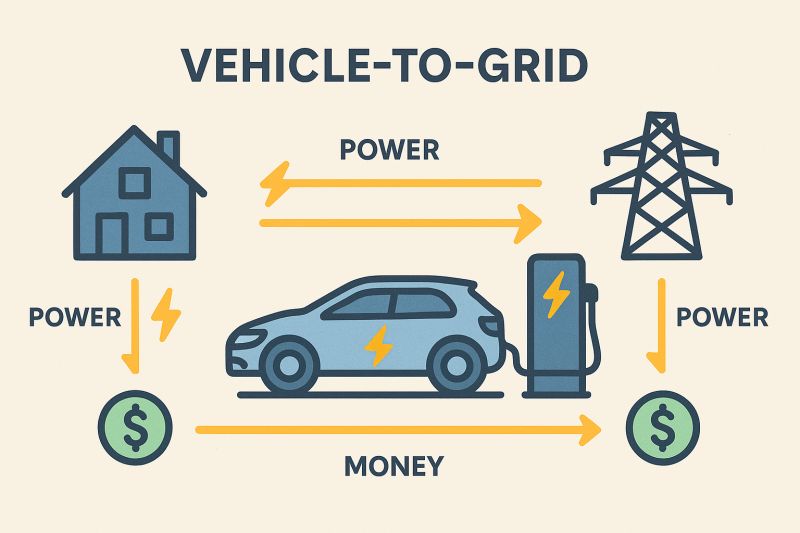
A way to accelerate local storage is to use the large batteries in EVs to power our homes (Vehicle to Load V2L) or to feed into the grid (Vehicle to Grid V2G), collectively these are known as V2X. My Powerwall has 13kWh, but my car has five times as much at 70 kWh. I already own the car, so no further investment is needed, and my car sits on my drive 90% of the time.
My EV was just over £40k, which gives a cost of around £600 per kWh. A home battery is about £7k which is £530 per kWh. I could get a cheaper older car, like a Prius for £12k with a 30 kWh battery at £400 per kWh.
My home battery is saving me about £1000 per year. Unfortunately, it’s not the case that a battery five times larger will deliver £5000 per year. Much of the savings from my home battery are because I’m avoiding peak hour charges. If I have a battery that is larger than my consumption, I only get the feed in rate of 15p which reduces the benefits to more like £2200 per year.
Am I trashing my car’s resale value by doing this?
The brand-new car will probably depreciate by 50% over 4 years. Using it for V2X could knock a further £10k off the value, leaving me with a car only worth £11k. I made £2200 per year for 4 years, and I lost £10,000 in value so I’m down £1200 on the equation.
The Prius does a bit better, I’m not making as much money, more like £1500 per year, but the hit to its value is far less, after 4 years I could have a car worth £6k, I’ve made £6k and lost £6k in value so at least I am even on the deal.
What else could we do?
Participating in flexibility and ancillary markets could give me a few hundred pounds a year more. My local network company could pay me to help them balance the local network if I lived in an area where there is insufficient capacity.
Maybe I could move to a dynamic tariff that would allow my value to more closely track the real cost of electricity, which could be ten times higher in the peak than off-peak. The risk here is that I accidentally use energy in the peak and end up with a huge bill.
I could join a Virtual Power Plant (VPP) where I give up control of the car battery to an aggregator in return for greater returns but lower risk.
My neighbours and I could also start to work together. If we shared our batteries and laid some cables across our connected gardens we could become our own local energy system, and by more effective use of our batteries and avoidance of standing charges make greater savings.
The reality is that there are no easy answers, and despite the obvious benefits to the whole system, it’s not easy to make V2G make good returns.