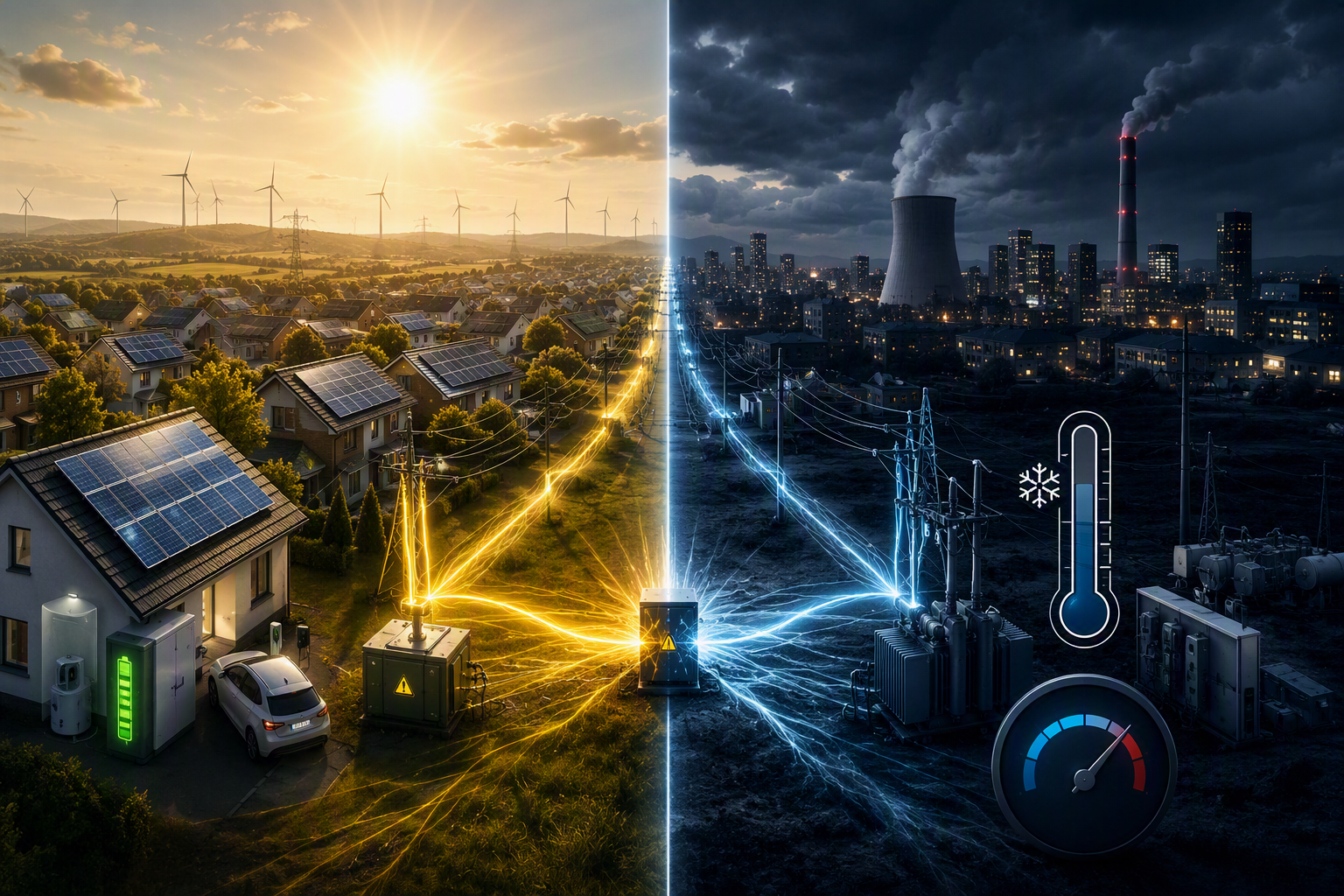
The dunkelflaute (a low wind, low solar, high demand winter period) has been worrying the energy industry for a while, but now we have the spectre of its equally troublesome sibling in the summer burn out caused by our success with renewables deployment.
In the summer solar production peaks, local voltages spike, and transformer protection circuits could start disconnecting. Painful when it’s your street, a regional problem when this cascades across a town, and a national problem when large areas of demand are unexpectedly disconnected.
The winter scarcity of electrons becomes a surplus in the summer.
Solar production and power use aren’t always in the same place. Residential solar deployment in suburban and rural towns are often miles away from industrial centres and cities where midday aircon would be welcome.
The solutions to the dunkelflaute problem, whilst not implemented, are at least understood – long generation storage, firm dispatchable power (gas, nuclear), and increased transmission build. Solutions to the summer problem have been discussed less frequently and are at such a scale and distribution that there won’t be simple answers. Some solutions work in both summer and winter – storage, flexibility, networks.
Unfortunately, UK solar inverters weren't designed to be remotely switched off by distribution companies to control exports. Changing the rules will take time, require equipment manufacturer changes, and importantly consumer engagement on the subject of how they are paid for not exporting.
Some flex market trials have introduced ‘turn-up’ payments, we don’t currently have a widely accepted way of doing this and no common distribution market signal to increase demand. In many cases it’s not clear that local consumers could increase demand anyway – the washing machine will only run once and the battery is already full from cheap overnight power.
Australia is the laboratory bench for this situation, and they have done a lot of work on curtailment, but domestic solar is already widespread, they all have aircon, and consumers always knew that curtailment was possible when they installed the panels.
For a long time, we’ve used scarcity to create price signals that result in development of energy assets. Creating value from abundance is a novel problem which we will need new thinking to solve.