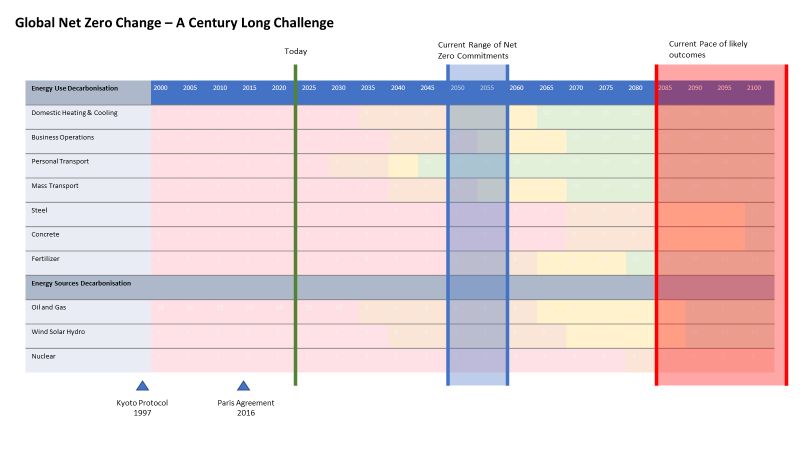
I mapped out the areas we need to decarbonise to hit Net Zero and concluded that 2050 is not realistic.
On the demand side we need to sort housing, business, personal and bulk transport, and a set of industrial processes like steel, fertilizer, and concrete. We may achieve personal transport before 2050, but the rest will be the second half of the century with the hardest to reach taking to 2100 (which sounds like a sci-fi time zone).
On the supply side we will continue to use fossil fuels for as long as they are the cheapest and most convenient fuel source, even if we do reach peak oil in the next few years as the IEA say. Solar and Wind need to be orders of magnitude larger than they are today, and nuclear needs to build hundreds of large complex power stations and thousands of smaller ones. Wind, solar, and nuclear take to 2100 to reach the level required. The Grid will match and in some cases set the pace of this change.
We will not achieve Net Zero until 2100.
We need a different way of thinking about this problem. We are currently stuck in an unhelpful competition between energy technologies, we have unrealistic deadlines, and commitments made by people that won’t be around to deliver them.
A programmatic, phased, and deliberate plan is needed. Rather than asking countries for commitments we should ask for plans.
An example – in the UK we have 4 million houses that could have a heat pump fitted today. We will also build a further 1 million houses in the next 5 years. A realistic and short-term target is to have 5 million heat pumps installed by 2030. Forcing a heat pump into each new home will stimulate the supply chain. We have the data that shows the networks precisely where the 4 million houses are. Cross industry planning could have this plan cracked before Christmas (this year).