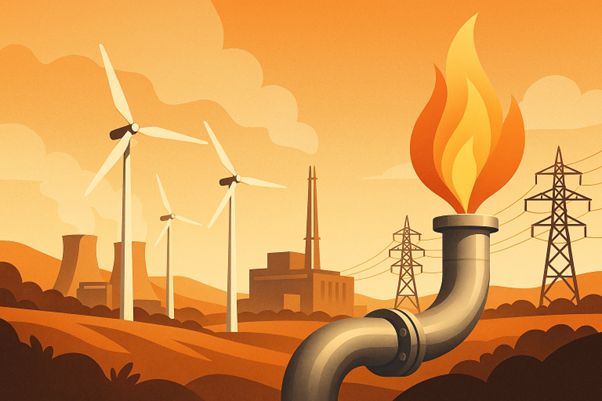
Not everyone shares the same view on the role of gas in the energy transition, some believe that it is a fossil fuel that’s in terminal decline, some see it as essential to system stability through the transition, and some believe that we will still be cooking Christmas turkeys on gas in 2100.
Gas is no longer the predictable and steady commodity.
Since 2010 our use of gas has dropped about 20%, but in end-user energy terms we still use around twice as much gas as we do electricity (have a look at the kWh values on your energy bill). Our sources of gas are also changing, before 2004 we were net exporters of gas, we now import roughly half of what we need.
As coal fired power stations closed gas moved in to fill the gap, and by 2010 it had become the dominant generation fuel. These stations were originally running 24x7 but now are used more dynamically to top up renewables, which is beginning to cause issues for reliability in assets designed to run continuously.
We used to store gas in holders in every major town, these acted as giant batteries that were filled overnight and released energy during the day. Advances in the management of the gas system rendered these redundant as ‘linepack’ – which is the pressurised gas in the transmission system pipes was a better alternative. The gas system remains a significant buffer to the GB energy system helping to balance peaks in our energy needs.
The way that we source and use gas is changing and difficult to predict: Data centres that are unable to get connected to the electricity network are planning to install their own gas fired generators. A small, but growing, number of houses have moved off gas completely, mostly to heat pumps, and this may grow if the government sticks to the 2035 ban on new gas boilers. Most of NESO’s Future Energy Scenarios predict dramatic reductions in gas use, but they do indicate that there is a possibility of seeing higher gas use than they forecast. Are we really ready to live without gas?
The gas that we put through the system is also changing, in future we may blend biomethane and hydrogen into the system, meaning that the energy capacity of gas won’t be as uniform as it is today.
Ed Milliband’s Clean Power 2030 plan envisages a 5% role for gas in elect generation. It matters a lot whether this is a set of stations filling in the gaps which add up to 5% or we need to be able to run continuously on gas for 5% of the time. Given that we are only 4 years away from 2030 and we were still at 30% last year it looks unlikely that gas will be this low.
Given that the electricity system faces challenges in terms of both constraints and flexibility it is likely that gas will play a more dynamic role in our energy mix.